Price of Shipping Container in India: 2026 Cost Guide
Price of Shipping Container in India by size, condition and type, plus the freight, GST and delivery costs most quotes leave out.
INR 16,500 in origin terminal handling can sit above the container price for a 40-foot dry or high-cube box at Nhava Sheva, according to the carrier notice described alongside Nhava Sheva tariff information. That isn't the purchase price, ocean freight or delivery to your site. It's a useful warning for anyone comparing an attractive online listing with a contractor's delivered quotation.
The price of shipping container in India is best treated as two separate budgets: the asset you're buying and the work required to make it usable at your location. A credible estimate identifies both, rather than presenting an unsupported national price range.
Container Prices in India at a Glance
There isn't a substantiated current INR price range for every common container type in the available market references. Historical equipment prices help explain market behaviour, but they don't establish today's ex-yard prices for new boxes, reefers or converted accommodation. Converting those historical dollar prices into rupees wouldn't make them current quotations.
Use the following buying table to identify the right enquiry. Ex-yard means the price of the unit at the seller's yard, excluding separately quoted freight, port charges, GST and site delivery.
| Container type | Condition | Typical use |
|---|---|---|
| 20ft dry | Used, cargo-worthy. Obtain a dated ex-yard quote after inspection. | Site storage, tool stores |
| 20ft dry | New. Confirm whether the offer means unused or one-trip equipment. | Long-term storage, clean fit-outs |
| 40ft dry or high-cube | Used. Request separate prices for each format and grade. | Bulk storage, warehouse overflow |
| 40ft high-cube | New. Confirm dimensions and availability in the quotation. | Taller storage, permanent installations |
| 40ft reefer | Used. Obtain a quote identifying refrigeration condition and test scope. | Cold storage, perishable goods |
| 20ft modified site office or bunkhouse | Refurbished. Request a layout-specific fit-out quotation. | Site offices, worker accommodation |
Read the specification before the price
Start with the intended use, not the cheapest listing. Dry storage needs a different acceptance standard from an occupied office, while a reefer enquiry needs to address the refrigeration machinery as well as the shell.
Ask the seller to identify the actual unit, its yard location and the scope included in the offer. A photograph of a representative container isn't enough to approve the condition of the container you'll receive.
Budgeting rule: Treat an uninspected catalogue price as a lead for an enquiry, not an approved project cost.
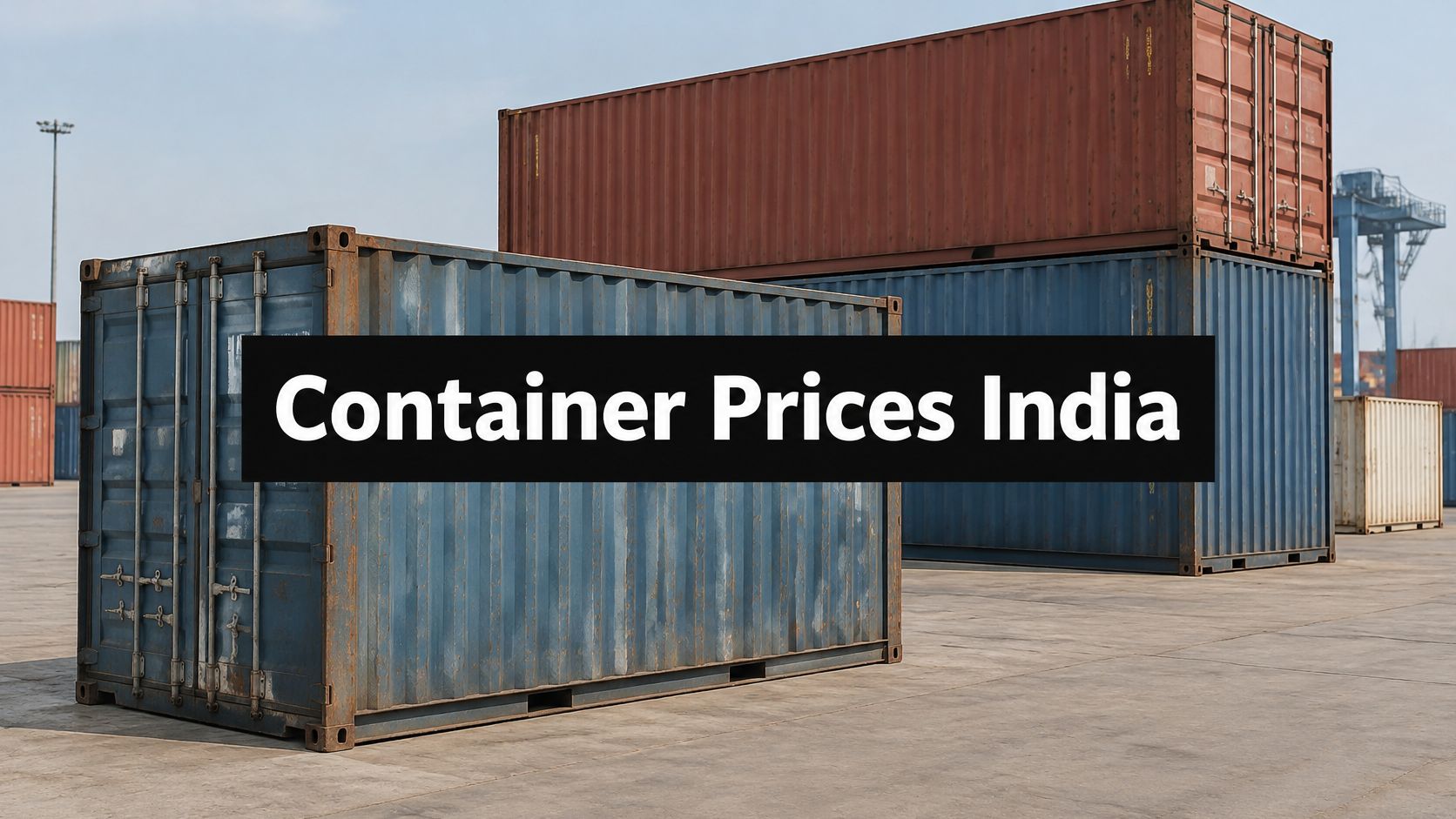
For basic storage, begin by comparing used dry boxes against your space and condition requirements. For accommodation, establish the finished specification before choosing a bare box. Without comparable quotations, neither a cheap shell nor an apparently complete module tells you which option costs less.
What Drives Container Prices and How Size and Condition Set Them
Container pricing follows equipment availability and location, not steel weight. A buyer needs the right box in the right yard, and moving surplus equipment to a shortage location costs money.
The market timeline
The useful historical sequence is a pre-disruption baseline, a pandemic-era peak, a partial correction and later transport pressure. These phases explain why an old price list isn't a reliable purchasing benchmark.
- Baseline and freight shock: Logistics Insider reported average cargo-worthy 20-foot dry equipment prices of about US$900 in July 2020, while citing the Federation of Indian Export Organisations' report that India-to-US freight for a 40-foot container reached US$6,200–6,500 in 2021, compared with about US$2,000 before the pandemic.
- Peak and partial correction: FreshPlaza's Indian container-market report places the equipment-price peak in August–September 2021, followed by declines from mid-January 2022, yet records Nhava Sheva's average cargo-worthy 20-foot dry price at US$2,269 on 23 April 2022, against US$1,341 on 1 January 2021.
Those are different measures. The first comparison includes the price of transport; the second concerns ownership of the equipment. Buyers shouldn't use a freight-rate headline as a container purchase-price benchmark.
The pricing factors can be read as a timeline, with size and condition determining the individual quotation.
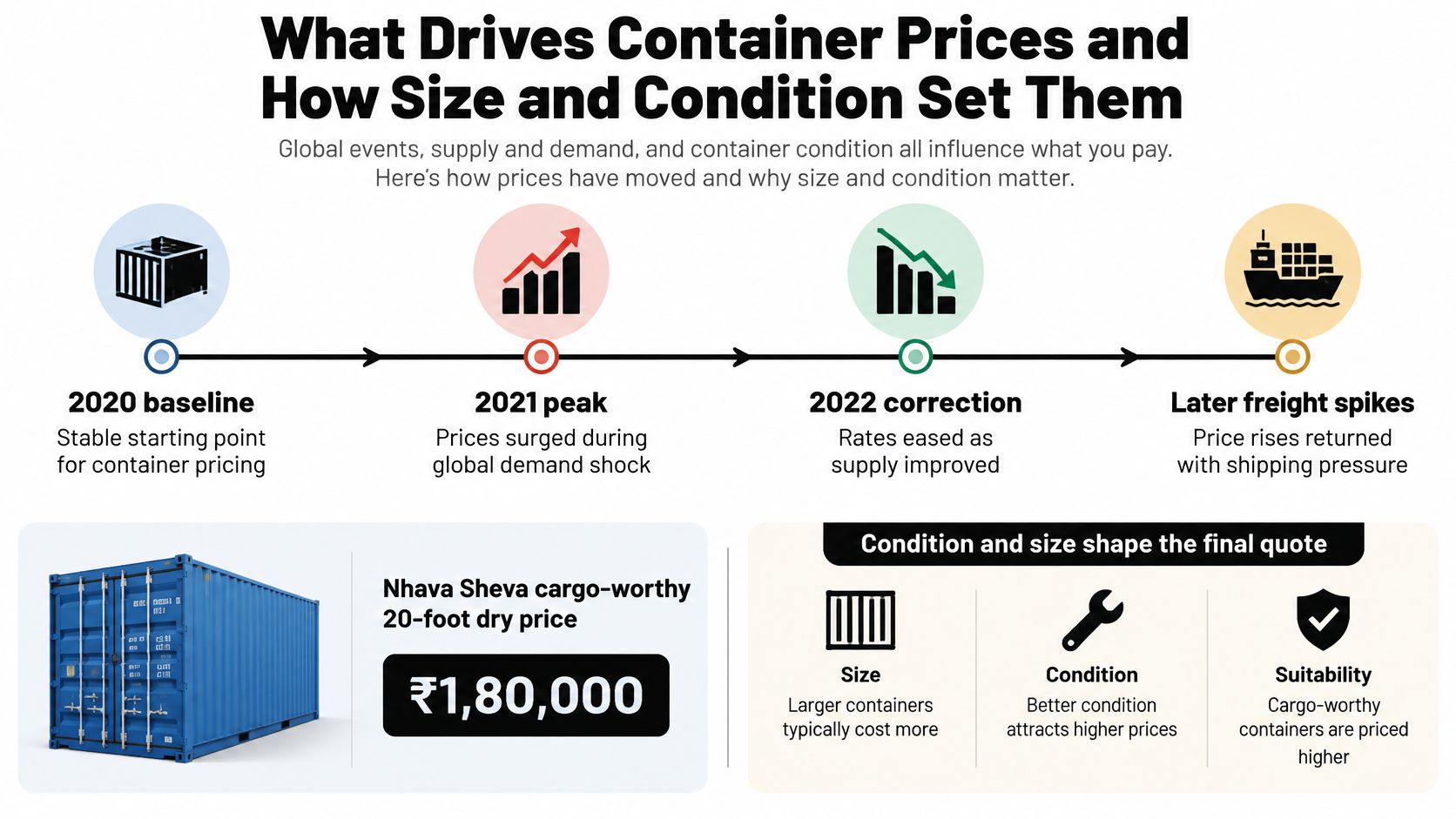
Compare usable space and condition
A longer box offers more storage space, but evaluate cost per usable storage position, not length alone. Door access, shelving, aisle clearance and the site's unloading arrangement determine how much of that space your team can use. High-cube equipment adds height, which matters only if the stored materials or proposed fit-out need it.
Condition descriptions also require care:
- One-trip: Usually describes equipment sold after an initial cargo journey. Confirm the seller's definition rather than equating the label with an untouched factory unit.
- Cargo-worthy: Indicates suitability for cargo service subject to the relevant assessment. It doesn't promise an immaculate appearance.
- Wind and water tight: Describes protection against weather ingress. Don't assume it establishes fitness for loaded transport or heavy structural use.
Inspect the floor, door seals, corner posts, rust holes and previous repair welds. Open and close both doors, examine the underside where accessible, and ask for repair details where corrosion has been patched.
For a larger storage requirement, compare the container option with a building-based solution using a consistent scope. A PEB structure cost comparison can help frame that decision, provided foundations, access and installation are included on both sides.
Buy the smallest practical format and the least costly condition that meets the intended duty. Record the quotation's validity date, because a condition grade doesn't protect you from a change in yard availability.
Freight, Port, Duty and GST Above the Box Price
The delivered budget needs a route-specific cost schedule. Some layers apply only to imports; others apply even when you buy stock already in India.
| Cost layer | What it covers | Example figure or pricing rule |
|---|---|---|
| Origin terminal handling | 20ft dry at Nhava Sheva | Obtain the applicable carrier tariff and confirm whether loading is included |
| Origin terminal handling | 40ft dry or high-cube at Nhava Sheva | Check the carrier's equipment-specific charge |
| Ocean freight | Shanghai to Chennai, 40ft | Obtain a dated booking quotation for the actual shipment |
| Storage and dwell | Delayed pickup at port | Apply the relevant tariff slab to the actual dwell period |
| Last-mile trucking | Port to project site | Quote against route, equipment and site access |
| Crane placement and inspection | Site setting and checks | Quote the lift plan, mobilisation and inspection scope |
Don't add every possible fee automatically. First identify what the supplier, carrier and transporter already include. Otherwise, a supposedly cautious budget can double-count handling or delivery.
Separate freight from the asset
A Free Press Journal report on China–India freight puts September 2026 Shanghai-to-Chennai freight at about US$3,900 per 40-foot container. That is a dated transport reference, not the selling price of an empty box or a standing offer for your shipment.
A low overseas purchase price therefore needs a second test: what will the carrier charge for the actual movement? Confirm that the booking quotation covers your equipment and shipment arrangement rather than assuming a published cargo rate can be applied unchanged.
Storage deserves its own allowance. Arrange documentation, vehicle availability and site readiness before release, then ask who pays if collection is delayed. Distinguish terminal storage from any separate equipment-related detention or demurrage provisions in the booking terms.
Correct the tax assumption early
The Asia Containers guide to GST on shipping containers identifies HSN 8609 and 18% IGST as the general treatment, notes possible basic customs duty and social-welfare surcharge on imports, and explains that import IGST applies to the assessable value plus applicable duty and surcharge. Applying the tax rate only to the supplier's factory price can therefore understate the import cash requirement.
Treat that guide as a costing starting point, not a classification ruling for every modified product. Have the customs broker confirm the classification, valuation basis and applicable charges in writing before approving an imported unit.
Build the import worksheet in this order:
- Supplier invoice: Record currency, equipment specification and commercial terms.
- Ocean freight: Enter the actual carrier or forwarder quotation.
- Insurance: Identify the cover and who arranges it.
- Port and terminal charges: Separate origin and destination items.
- Customs duty: Use the broker-confirmed assessment.
- Surcharge: Enter the applicable amount separately.
- IGST: Apply the confirmed tax treatment to the correct base.
- Customs-broker fees: Include clearance and documentation services.
- Inland haulage: Price delivery to the actual project gate.
- Inspection and contingency: Keep identified checks separate from an allowance for unresolved exposure.
The procurement cash budget and the final accounting cost aren't necessarily identical. Have finance determine whether any tax credit is available rather than subtracting anticipated credits from the money needed for clearance.
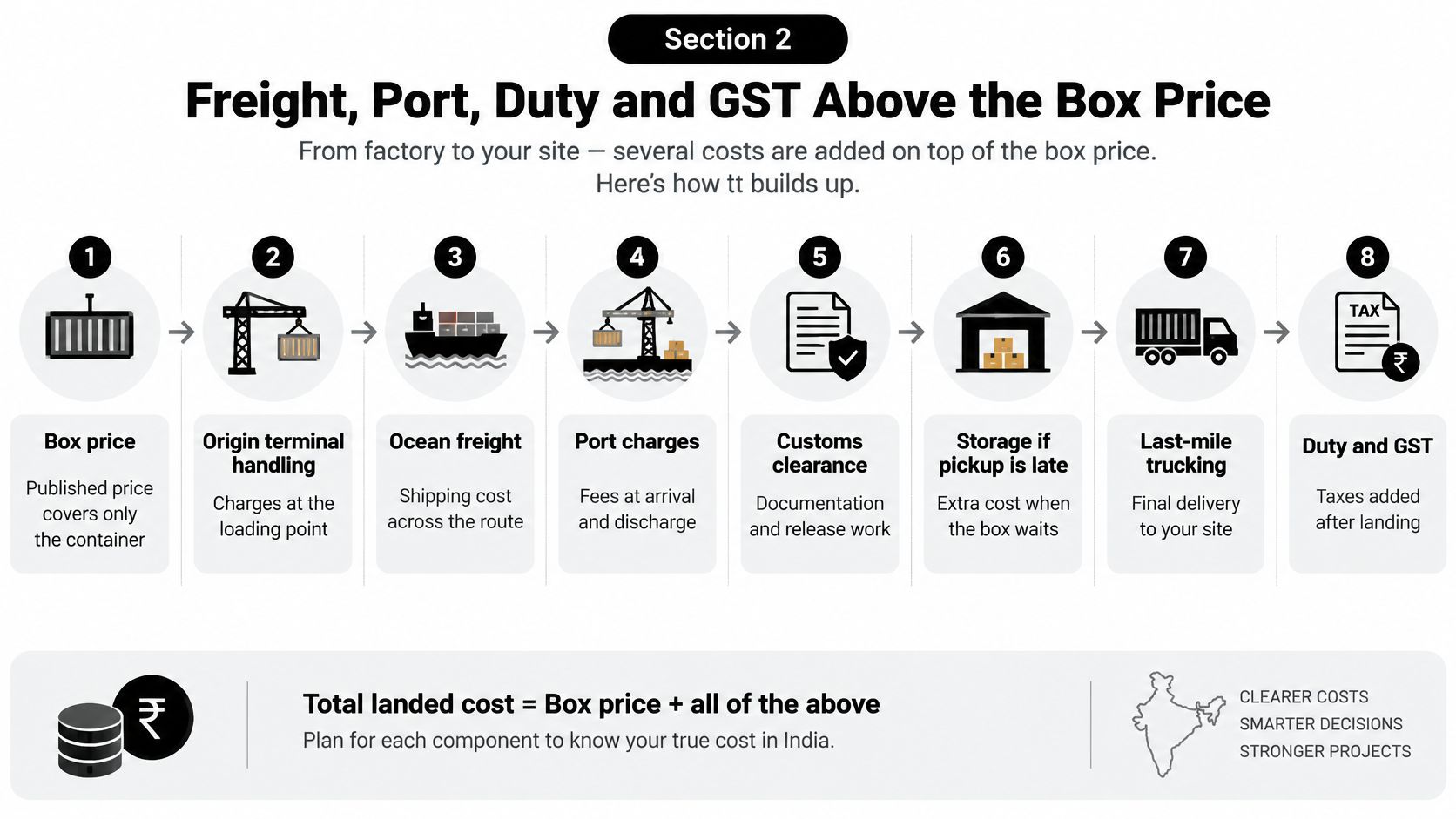
A customs release isn't the same milestone as a usable container standing safely at your project site.
Permanent ownership and temporary admission also require different budgets. The same GST guide describes duty-free admission for eligible durable, reusable, identifiable containers re-exported within six months, under bond and supporting documentation. This isn't a general discount on containers intended to remain in India.
Ask the broker to document eligibility and compliance responsibilities. If both routes are feasible, prepare a tax-paid ownership scenario and a temporary-admission scenario, including the obligations needed to close the latter.
Worked Landed-Cost Example for a Delivered 40ft Box
Consider an imported dry box intended for a project near Chennai. The defensible calculation uses your invoice and route-specific quotations, rather than combining a Chennai freight reference with an unrelated Nhava Sheva origin charge.
Build the calculation with named inputs
Use a spreadsheet with these entries:
| Worksheet input | What to enter |
|---|---|
| B, box price | Supplier invoice converted using the exchange-rate basis appropriate to the budget |
| L, logistics | Origin handling, freight, insurance, destination charges, broker fees and inland haulage |
| T, taxes | Broker-calculated duty, surcharge and import tax |
| S, site acceptance | Crane placement, inspection and agreed repairs |
| C, contingency | A separately approved allowance for unresolved costs |
First, enter B without modifications or transport hidden inside it. Next, populate L from the actual route quotation, checking each charge against the supplier's commercial terms.
Then obtain T from the broker's assessment worksheet. Don't calculate import tax by multiplying the bare-box invoice alone. Finally, enter S against the site lift and acceptance scope, and identify the specific uncertainties covered by C.
Show the approval request as two lines:
- Container asset line: B.
- Logistics, tax and site line: L + T + S + C.
Delivered budget = B + L + T + S + C.
An unquoted item should read quotation outstanding, not disappear into a blank cell. This approach won't produce a false-looking precise total, but it will show the procurement manager exactly what remains unresolved before placing the order.
Modification Costs for Site Offices and Bunkhouses
Start with the bare-box specification, then price the occupied space. An office or bunkhouse needs a defined layout, service connections and acceptance criteria, not just a container with openings cut into it.
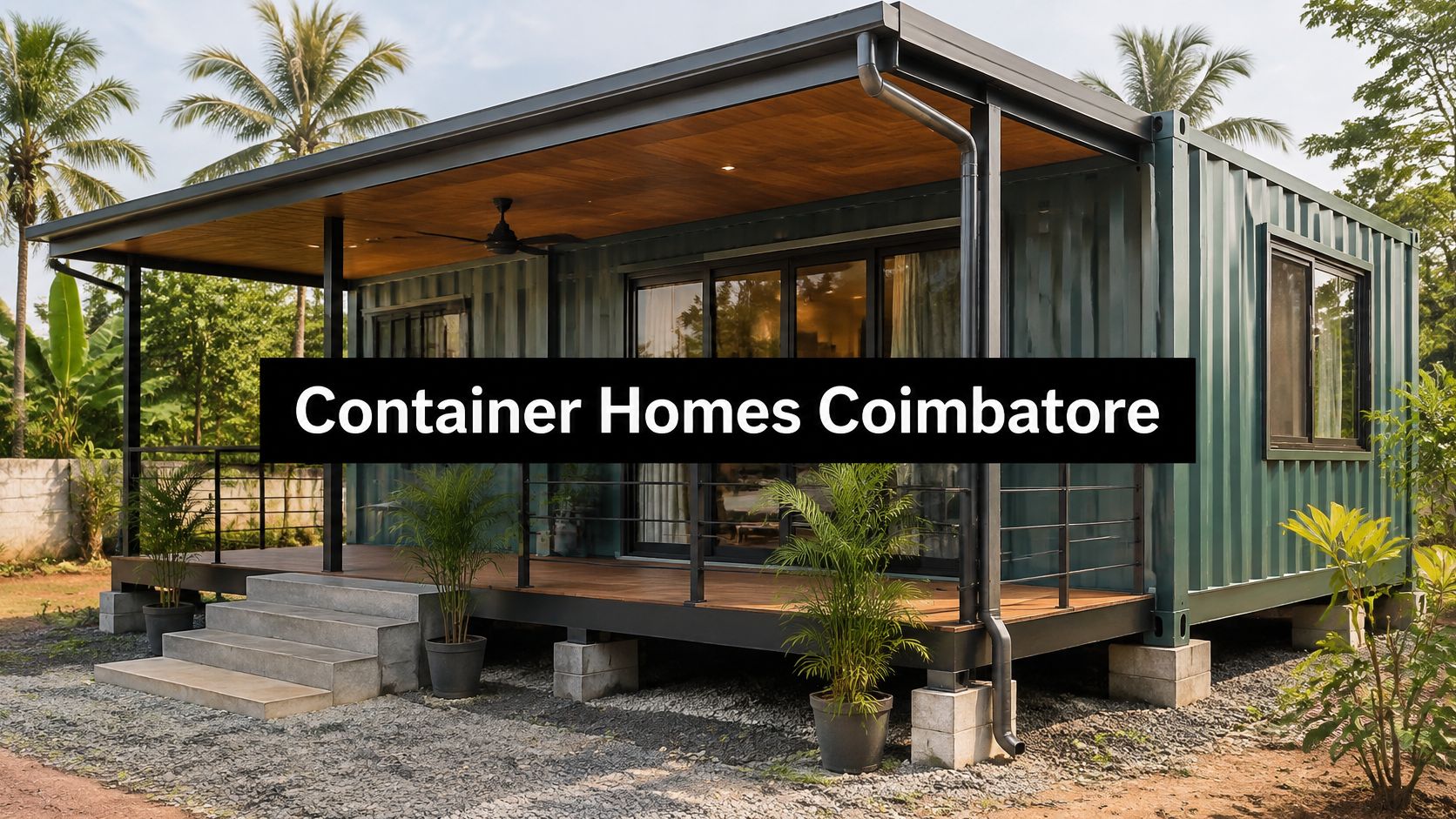
At Heyaansh Industries Pvt Ltd, we offer worker bunkhouses with container layouts and fit-outs, alongside application-specific Custom Industrial Containers. Final layout, services, dimensions and commercial terms are confirmed against the enquiry.
| Add-on | What it changes |
|---|---|
| Full-roof shade canopy | Roof shading and heat reduction. Our Full-Roof Shade Canopy costs ₹66,000 + GST per container |
| Door and window cuts | Ventilation, daylight and access. Price against the opening schedule and reinforcement design |
| Insulation and ceiling | Heat and noise control. Specify the material, lining and installation scope |
| Electrical and lighting | Lights, sockets and fans. Quote against the electrical schedule |
| Air conditioning | Cooling for occupied units. Define equipment, installation and electrical provisions |
| Toilet and shower units | Sanitation. Include fixtures, plumbing and connection boundaries |
Specify the finished room
Mark desks, beds, partitions, doors and equipment on the proposed layout before approving fabrication. Check whether an opening requires reinforcement and how the fabricator will reseal cut edges and penetrations.
The internal work matters as much as the external appearance.
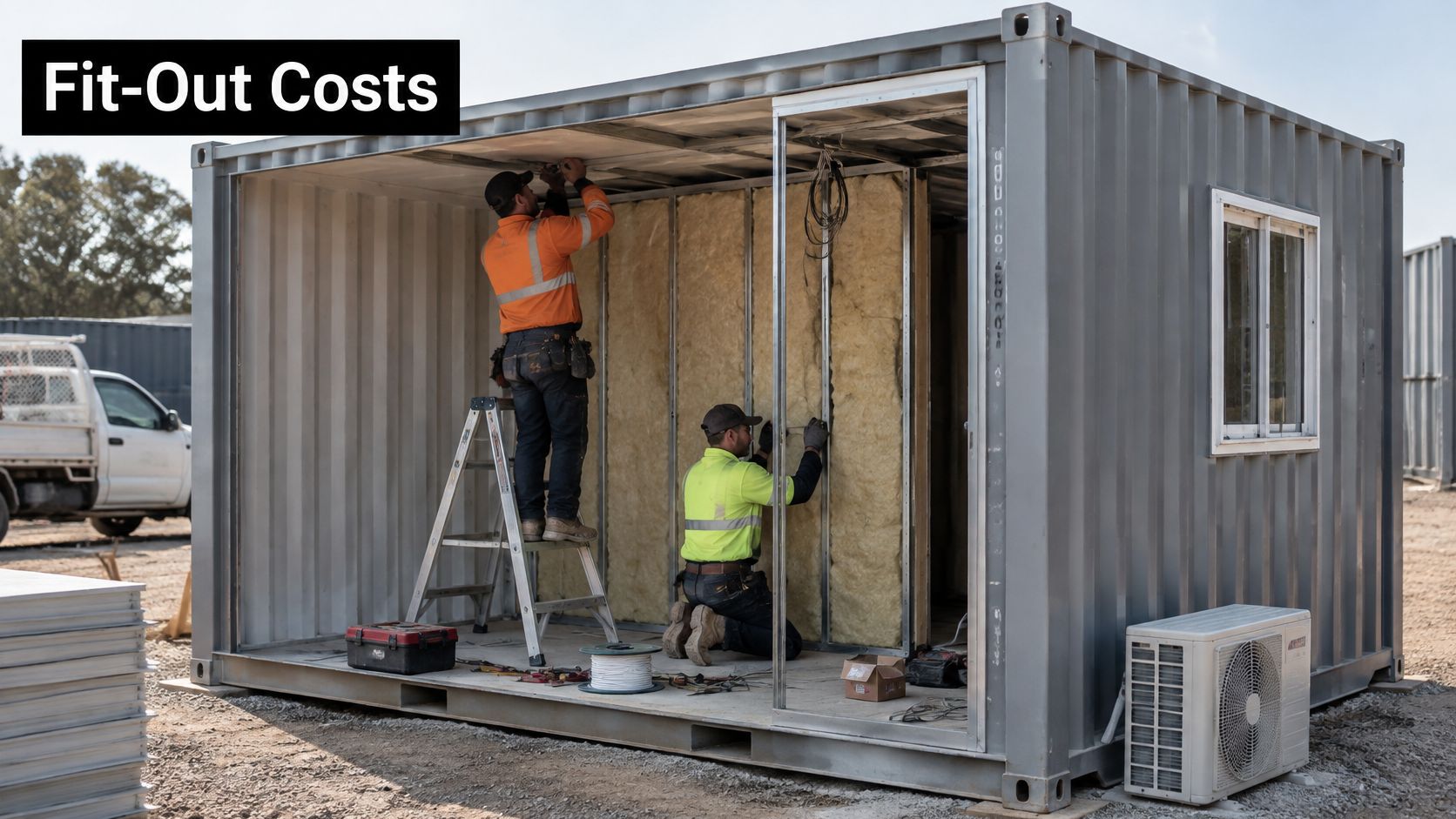
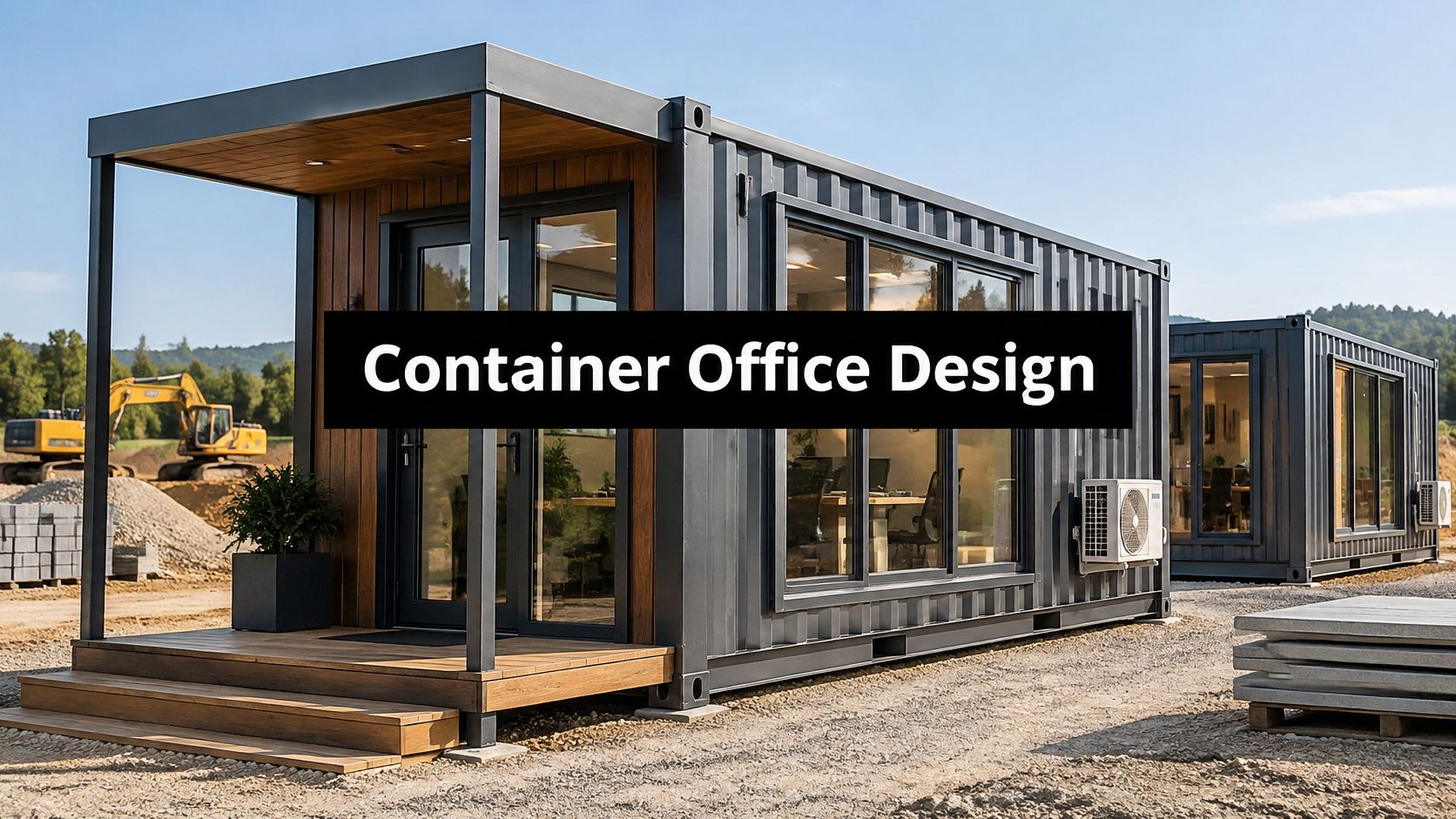
Use a container office design specification to turn intended occupancy into a drawing and service schedule. Include lighting positions, sockets, air-conditioning provision and furniture clearances so competing quotations cover the same room.
For sanitation modules, define where the fabricator's work ends and the site contractor's work begins. Water supply, drainage, external power and foundations shouldn't be assumed to be included merely because the unit contains a toilet or shower.
Scope check: Compare a complete fabricated module with a bare-box conversion only after both offers include the same finished condition.
A conversion can cost more than its starting shell, but no universal multiplier is defensible without the specification. Budget the whole fit-out before selecting the container size, and keep optional additions separate so you can adjust scope without losing sight of the usable finished cost.
Choose the Right Source and Compare Delivered Quotes
Prioritise local stock for a tight schedule, investigate imports for consolidated demand with practical port access, and consider fabrication for a custom layout. These are screening rules, not guarantees. Each route still needs a comparable delivered quotation.
Make inspection part of supplier selection.
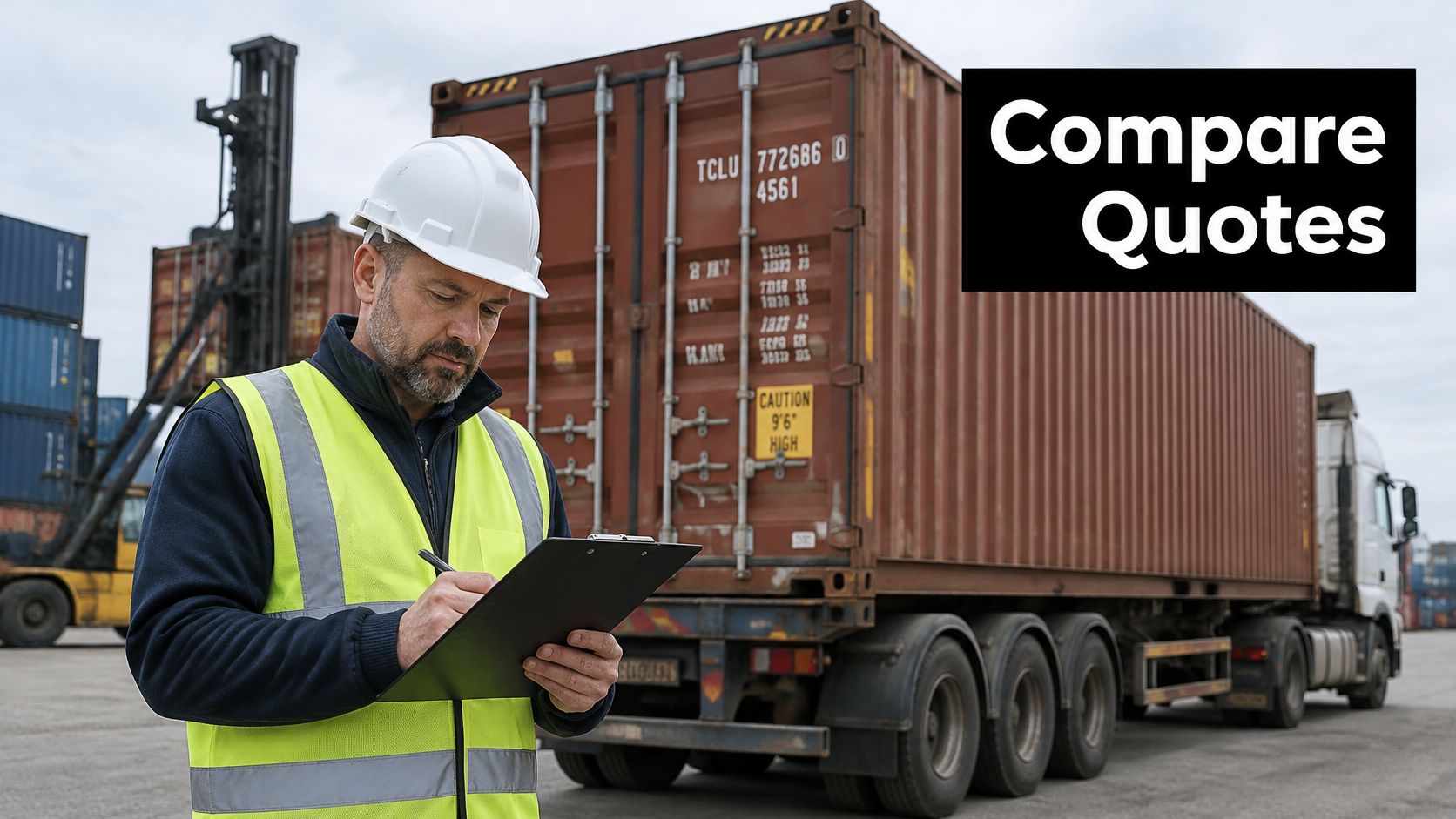
Route sensitivity is substantial: Sourcing Journal's India–US shipping report records India-to-US East Coast spot freight at about US$11,000 per 40-foot container in September 2026, against US$1,960 in May. That outbound route isn't a direct import-cost benchmark, but it illustrates why a transport assumption needs its own validity period.
Issue a comparable enquiry
- Define the duty. Specify size, condition grade, intended use and inspection requirements.
- Prepare the BOQ. We ask for product sizes, grades, quantity, delivery location, timeline, documentation requirements and GST details.
- Submit the configuration. Open the relevant product page and use its enquiry option to share intended use, quantity, location, preferred layout and required services.
- Compare the same endpoint. Request freight-inclusive and freight-exclusive versions, each with validity dates, exclusions and a delivered-to-site total.
Our containers for business options include enquiries for bunkhouses, site offices, sanitation and custom modules. Our container fabrication facility is at A1A MMDA Industrial Complex, Maraimalai Nagar, Kanchipuram 603209; use the actual dispatch point when pricing haulage.
For additional visual context, the following video accompanies the buying decision.
Choose the offer with the clearest accepted specification, delivery responsibility and total commitment. The lowest shell price is only useful if the finished container reaches your site when you need it.
Heyaansh Industries Pvt Ltd offers custom container fabrication, site offices, worker bunkhouses and sanitation units for industrial projects. Visit Heyaansh Industries Pvt Ltd and submit your BOQ, delivery location, preferred layout and required services through the relevant product enquiry option to request a configuration-specific quotation.